
Screening
Health questions about allergies, kidneys, heart and medicines.
An IV drip sends fluids and nutrients straight into a vein instead of through your stomach. Here we explain what that means for absorption, what you will feel in the chair, who needs extra caution and how often a drip is reasonable.
Gangnam Celliting Clinic · 121 Teheran-ro, Gangnam-gu, Seoul · Gangnam Station Exit 12 (4-min walk)
IV drip therapy delivers fluids, vitamins or antioxidants directly into a vein, so they bypass digestion and reach the bloodstream fully. That is different from tablets, which are only partly absorbed. At Gangnam Celliting Clinic in Gangnam, Seoul, each drip follows a health screening for allergies, kidney and heart conditions and medicines, and frequency is set by the doctor, not by a package.
An IV drip puts the ingredients directly into your blood, while tablets must pass through the gut, where only part is absorbed. This means IV can reach higher blood levels for a short time, but higher is not automatically better for everyone.
| IV drip | Oral tablets | |
|---|---|---|
| How it enters | Directly into a vein | Through stomach and gut |
| Absorption | Complete into the bloodstream | Partial; varies by nutrient |
| Blood levels | Rise quickly, then fall | Lower, slower rise |
| Time needed | A clinic visit | A few seconds daily |
| Supervision | Medical staff present | Usually none |
For everyday nutrition, a balanced diet and, where needed, oral supplements remain the foundation. A drip is a targeted, supervised option for specific goals.
You sit in a comfortable chair while a thin cannula is placed in a vein in your arm and the fluid drips in slowly. Most people read, rest or use their phone.
Allergies, kidney disease, heart conditions and some medicines need to be discussed first, because the body must handle the extra fluid and ingredients. These do not always rule out a drip, but the formula, volume or speed may change.
The kidneys clear many IV ingredients, so reduced kidney function may limit what is safe.
Extra fluid can be a strain for some people with heart failure or similar problems.
Any reaction to vitamins, medicines or previous drips should be mentioned.
Pregnancy, breastfeeding and regular medication should also be mentioned during screening.
There is no single correct schedule; the doctor sets frequency based on your goal, health and response. More drips do not necessarily mean more benefit.
Suitability is a medical decision made by your doctor after an in-person consultation and review of your health history.
Health questions about allergies, kidneys, heart and medicines.
The doctor confirms which drip suits your goal, using the IV therapy menu as a starting point.
The drip runs at a controlled rate while staff check on you.
Sit for a few minutes before you stand up and leave.
Keep the plaster on briefly and contact the clinic if bruising spreads or the arm becomes red and hot.
A Gangnam-gu Official Partner Clinic with English, Chinese, Japanese and Vietnamese support.
Written aftercare in your language, a 24-hour line and a free 3-month follow-up.
Dr. Ho-chan Kim and Dr. Young-mi Rhee personally consult and treat. Nothing is handed off.
Long flights, heat and busy sightseeing days can leave travellers dehydrated, which is one reason many visitors ask about a hydration IV in Gangnam, Seoul. Book it on a day when you are not rushing to the airport, eat a light meal first and drink water afterwards. If you are flying the same day, mention it during screening. Support is available in English, Chinese, Japanese and Vietnamese.
Reviewed by Dr. Ho-chan Kim, MD, PhD · Updated October 2026
It enters the bloodstream faster because it skips digestion. Whether you feel a difference depends on your starting condition and the formula. People who are dehydrated may notice a change sooner than people who are already well nourished and hydrated.
Most people feel a short pinch when the cannula goes in, then little during the infusion. A cool or heavy feeling in the arm is common. Tell staff if you feel burning or increasing pain, as the cannula may need adjusting.
Most people return to normal activities straight away. If you felt light-headed during the drip, rest until it passes. Follow any specific instructions the medical team gives you after your session.
There is no single list, which is why screening matters. People with significant kidney or heart disease, previous severe reactions, or certain medicines may need a different formula or no drip at all. The doctor makes the final decision.
Frequent drips are not right for most people. The doctor decides frequency based on your goal, health and how you responded before. If you want regular drips, discuss the reason, as oral supplements or diet changes may be enough.
Message the team on WhatsApp or through the consultation form with your goal and any health conditions, and we will advise on next steps.
Medical information on this page is provided by Gangnam Celliting Clinic and reviewed by our medical directors. It is not a substitute for an in-person medical consultation. Individual results vary, and all procedures carry potential risks and side effects that your doctor will explain before treatment.
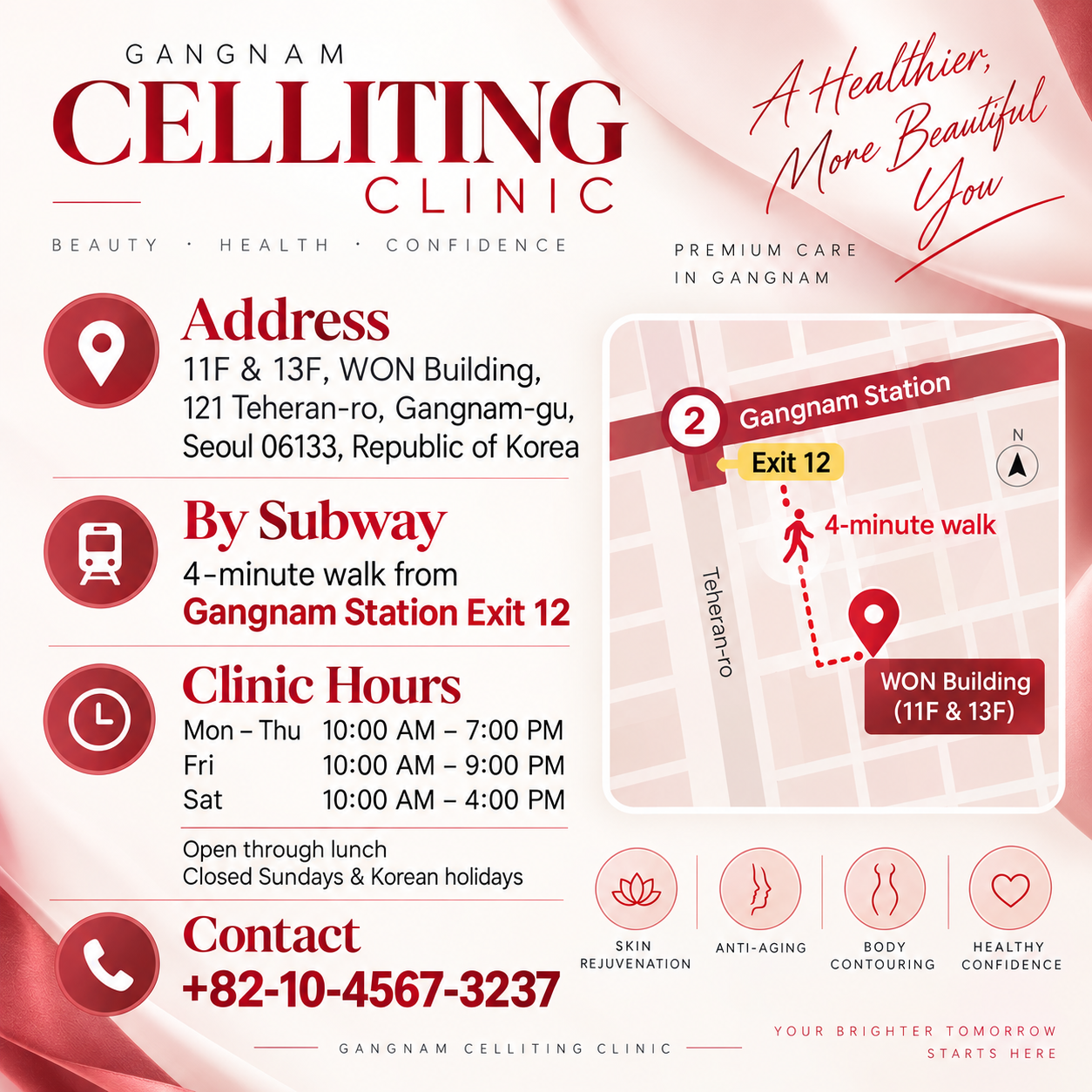
From skin lifting and stem cell treatments to regenerative skin care, our two MD-PhD directors plan every treatment personally. Send us your questions and travel dates.
Everything you need to plan a treatment trip to Seoul




How to find us


WhatsApp :
+82-10-4567-3237
Address : 11F & 13F, WON Building, 121
Teheran-ro, Gangnam-gu, Seoul 06133, Republic of Korea
Gangnam Station, Exit 12