
Name your main sign
Tell the team which change bothers you most, with photos taken in natural light.
Dull, crepey, loose or hollow: each visible sign of aging skin has its own cause. This page links seven common signs to what drives them and the medical options that may help, plus the sun habits that protect skin every day.

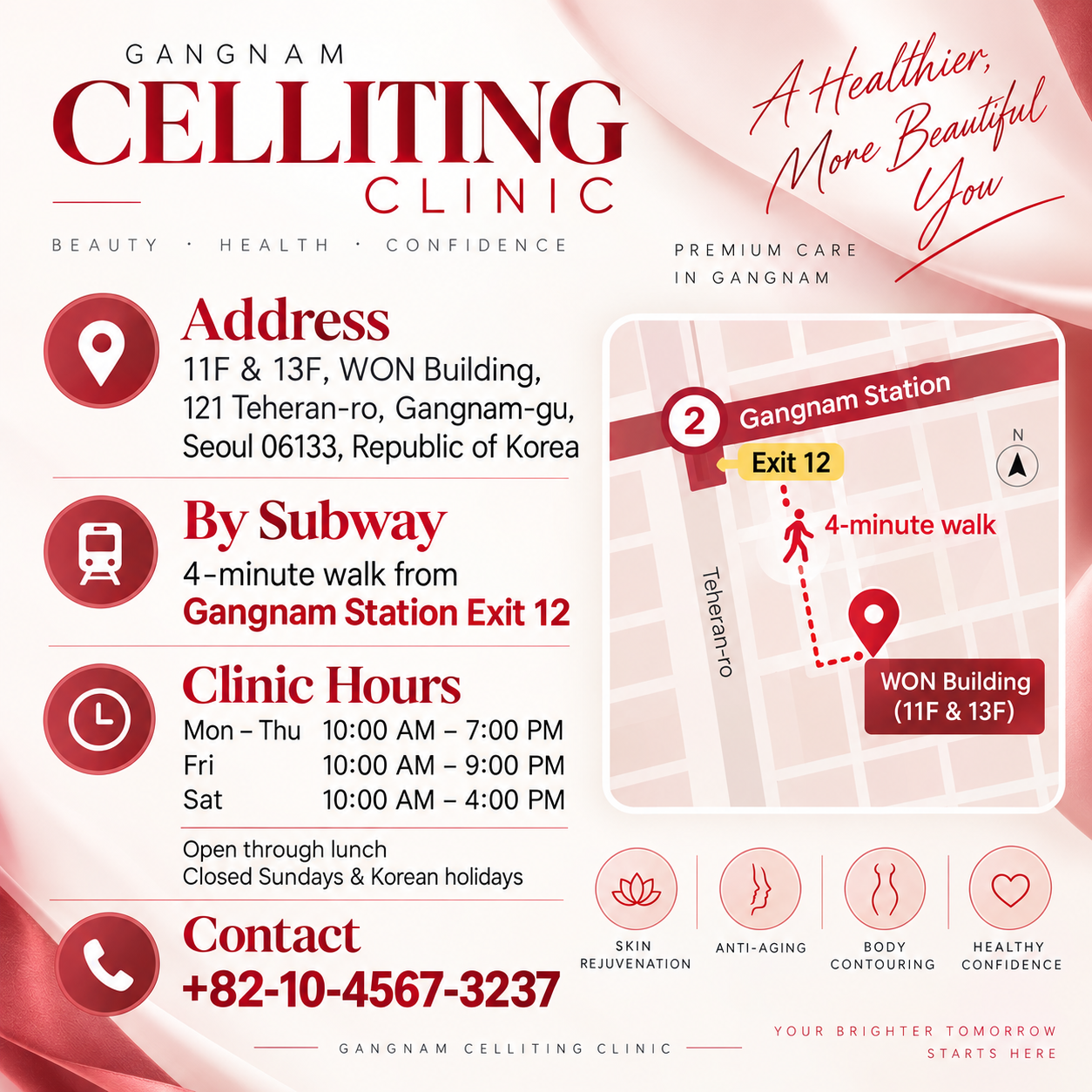
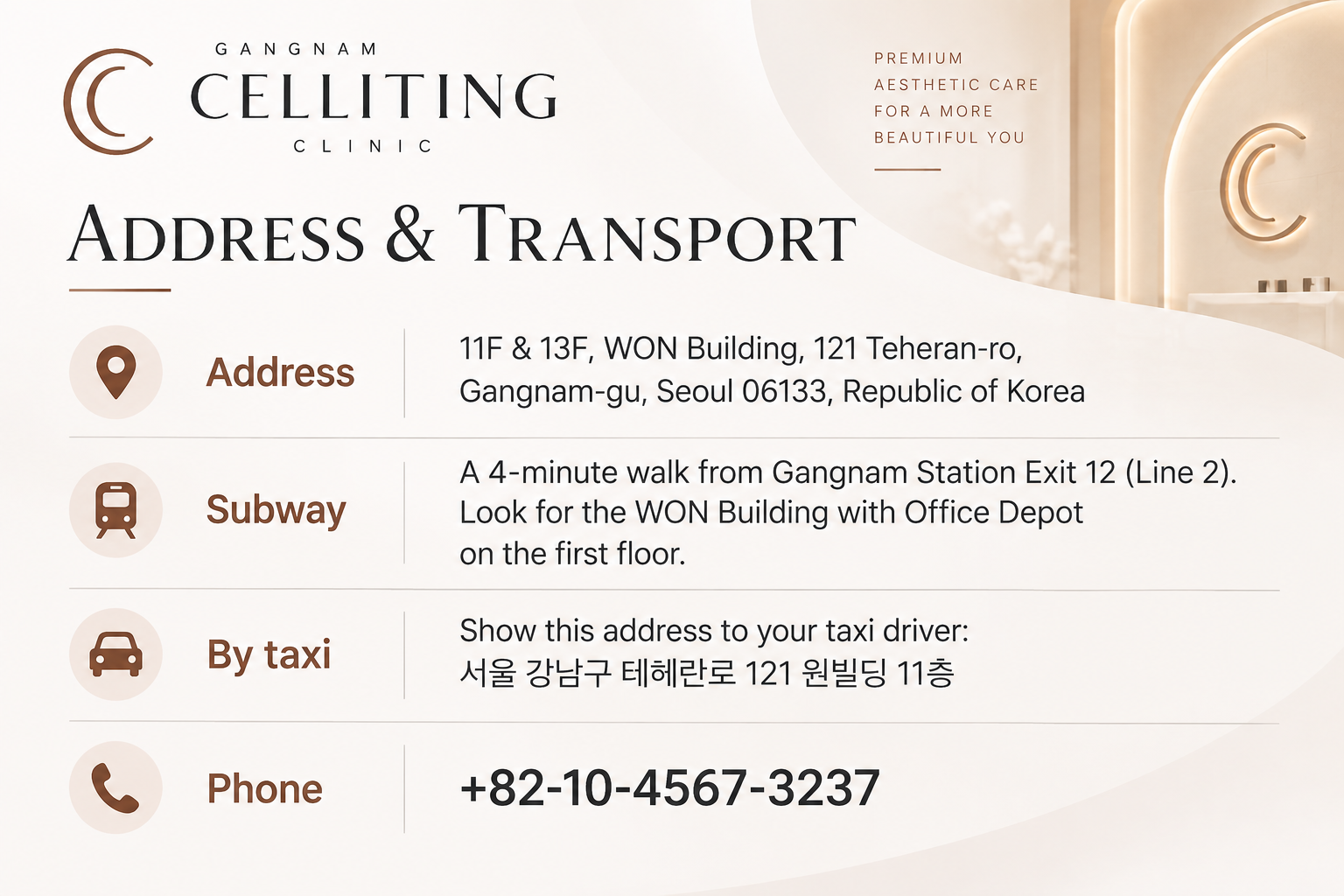
Gangnam Celliting Clinic · 121 Teheran-ro, Gangnam-gu, Seoul · Gangnam Station Exit 12 (4-min walk)
Aging skin treatments work best when they target the cause behind each sign. Dullness and uneven tone often reflect slower cell turnover and sun damage, fine lines and crepey texture reflect collagen loss, laxity comes from loosening deeper tissue, and hollowing from volume loss. Options range from skin boosters and exosome care to radiofrequency, focused ultrasound and Sculptra.
Each visible sign has a main cause, and the cause points towards the treatment. Use the table as a guide to discuss with your doctor.
| Visible sign | Main cause | Options that may help |
|---|---|---|
| Dullness | Slower cell turnover, dehydration | Skin boosters, exosome care |
| Fine lines | Early collagen loss, sun damage | Skin boosters, Sofwave, Thermage FLX |
| Laxity | Loosening deeper tissue and SMAS | Ultherapy PRIME, Thermage FLX, combined lifting |
| Crepey texture | Thinning dermis, damaged elastin | Sculptra, XERF, skin boosters |
| Enlarged-looking pores | Weaker collagen support, oil | Collagen-supporting RF, skin boosters |
| Uneven tone | UV-driven pigment, inflammation | Sun protection plus pigment-focused care |
| Hollowing | Loss of fat and collagen volume | Sculptra for gradual volume |
Intrinsic aging is the natural, genetically timed slowing of the skin; extrinsic aging is damage added by environment and lifestyle, mainly the sun. Both happen together, but extrinsic aging is largely within your control.
Collagen production slows gradually from early adulthood, skin becomes thinner and drier, and fat and bone support change. It tends to cause fine, even lines and gradual laxity.
Ultraviolet light, smoking, pollution and poor sleep add damage on top. It tends to cause rough texture, deeper lines, spots and uneven tone, often earlier than intrinsic changes.
Treatments can improve the appearance of both, but they work best when extrinsic damage is also reduced. Age-specific advice is on our pages for preventive anti-aging in your 20s and anti-aging in your 40s.
Sun protection matters most because ultraviolet light is the main driver of extrinsic aging, and it reaches your skin every day, cloudy days included. Without it, treatment results may fade sooner.

Suitability is a medical decision made by your doctor after an in-person consultation and review of your health history.
Tell the team which change bothers you most, with photos taken in natural light.
The doctor confirms the cause, checking texture, firmness, pigment and volume.
You hear which treatment fits the cause, how it works and the expected recovery.
The doctor performs the treatment, then gives sun-protection and skin care advice.
Share progress photos during the free 3-month follow-up after you return.
Dr. Ho-chan Kim and Dr. Young-mi Rhee personally consult and treat. Nothing is handed off.
Monitored sleep sedation, AirNox analgesia, the X-injector or local anesthesia, matched to the procedure.
A Gangnam-gu Official Partner Clinic with English, Chinese, Japanese and Vietnamese support.
Sightseeing means long hours outdoors, so pack a broad-spectrum sunscreen and a hat, especially in summer. If a treatment leaves your skin pink or sensitive, plan indoor activities such as museums or shopping for a day. Flights dry the skin, so moisturise on the journey home. Gangnam Celliting Clinic is about a 4-minute walk from Gangnam Station Exit 12 in Gangnam, Seoul, and aftercare is provided in English, Chinese, Japanese or Vietnamese.
Reviewed by Dr. Ho-chan Kim, MD, PhD · Updated October 2026
Treat the sign that bothers you most, as long as the doctor agrees it is the main issue. Laxity or volume loss often comes first because surface treatments look better on a firmer base, but if dullness is your main concern, a skin-quality treatment may be the simplest start.
They can often look smaller, although pores do not disappear. With age the collagen supporting each pore weakens, so pores may look larger. Treatments that support collagen and hydration may improve their appearance in suitable patients, alongside good cleansing and sun protection.
Not quite. Wrinkles are lines or folds, while crepey skin is a fine, papery texture across an area, linked to a thinning dermis and damaged elastin. It often responds better to collagen-supporting options than to treatments aimed at individual lines.
Yes, possibly more than before. Ultraviolet light keeps breaking down collagen and triggering pigment, which can shorten how long results last. Some treated skin is also more sensitive for a while, so daily broad-spectrum sunscreen protects both your skin and your results.
They can improve the appearance of sun damage, such as texture, fine lines and uneven tone, but they do not erase it completely. Results vary, and daily sun protection is needed to stop new damage building up after treatment in Gangnam, Seoul.
Send photos of the signs that concern you on WhatsApp (+82-10-4567-3237), and a Celliting doctor will help match them to suitable options.
Medical information on this page is provided by Gangnam Celliting Clinic and reviewed by our medical directors. It is not a substitute for an in-person medical consultation. Individual results vary, and all procedures carry potential risks and side effects that your doctor will explain before treatment.
From skin lifting and stem cell treatments to regenerative skin care, our two MD-PhD directors plan every treatment personally. Send us your questions and travel dates.
Everything you need to plan a treatment trip to Seoul




How to find us
WhatsApp :
+82-10-4567-3237
Address : 11F & 13F, WON Building, 121
Teheran-ro, Gangnam-gu, Seoul 06133, Republic of Korea
Gangnam Station, Exit 12