
Expression mapping
The doctor watches you raise, lower and relax your brows to map how the frontalis moves.
Horizontal forehead lines come from the frontalis, the muscle that lifts your brows. Treating them well means softening the lines without letting the brows drop. Here is how our doctors balance both.
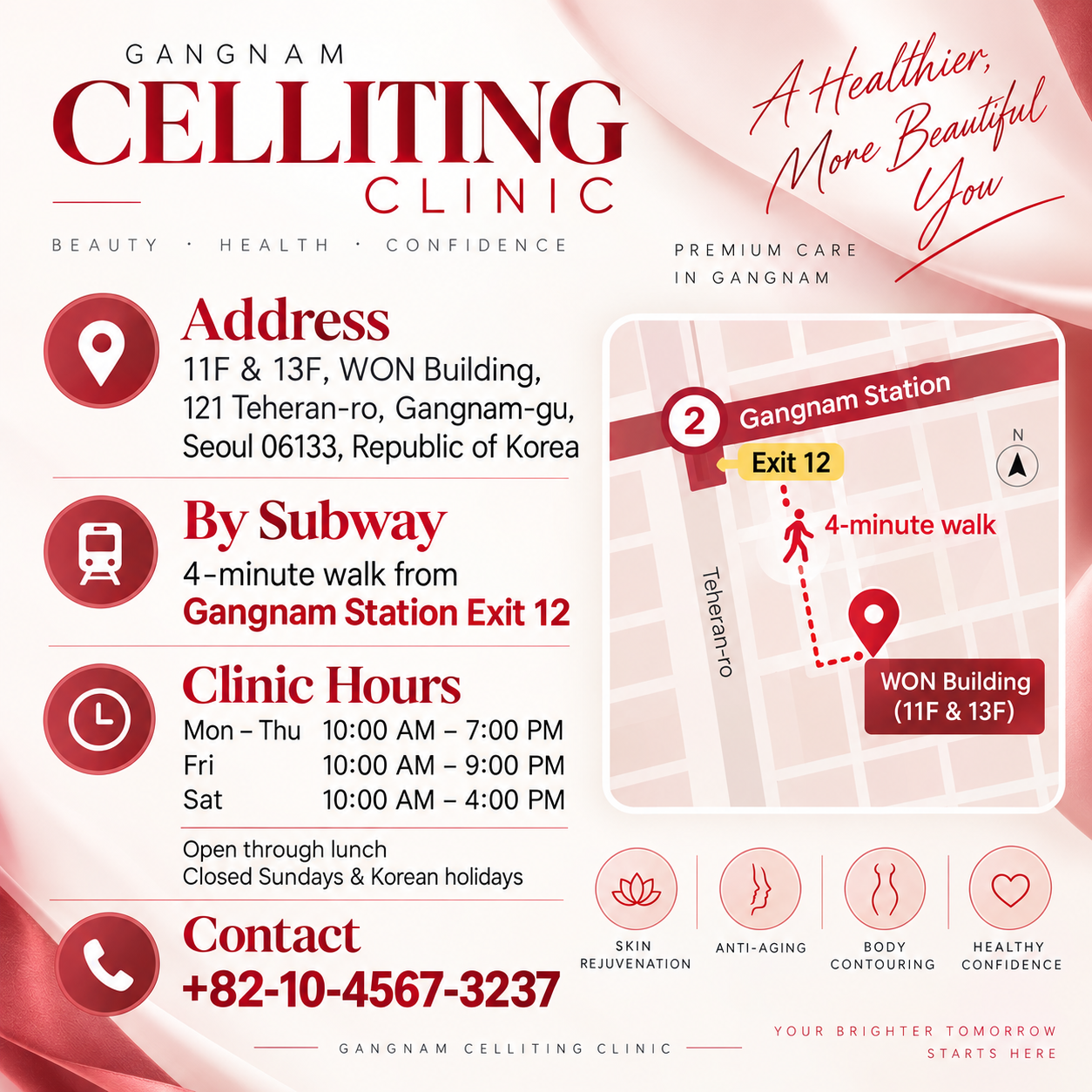
Gangnam Celliting Clinic · 121 Teheran-ro, Gangnam-gu, Seoul · Gangnam Station Exit 12 (4-min walk)
Forehead wrinkles are usually treated by relaxing part of the frontalis muscle with wrinkle Botox, which the clinic lists as a roughly 5-minute procedure with same-day recovery. Because this muscle also holds the brows up, dosing and placement must be careful. Lines etched in at rest may also need skin-quality or collagen support.
Horizontal forehead lines form because the frontalis muscle pulls upward every time you raise your eyebrows, folding the skin above it like an accordion. People who lift their brows when talking, reading or compensating for heavy upper eyelids tend to develop deeper lines earlier. Over years, falling collagen and sun damage let these folds remain even when the face is still.

Yes, it can if too much is placed too low, which is why a doctor-led assessment matters. When the lower part of the frontalis is over-relaxed, the brows may sit lower and the upper eyelids can feel heavier, especially in people who already rely on the forehead to keep their eyes open. This effect is temporary but can last as long as the product does.
Moving lines usually respond well to muscle relaxation alone, while etched lines that stay at rest often need a second, skin-focused step.
| Lines only when raising brows | Lines visible at rest | |
|---|---|---|
| What is happening | Active frontalis movement | Movement plus collagen loss |
| First option | Wrinkle Botox, conservative dose | Wrinkle Botox to reduce folding |
| Second step | Usually not needed | Skin-quality or collagen support |
| Expected change | Smoother forehead in motion | Softer, not erased, resting lines |
| Brow-heaviness check | Important | Especially important |
If skin laxity across the upper face is part of the picture, our skin tightening treatments page explains device-based options. For a wider overview of line types, see wrinkle treatments.
A natural result means your forehead still moves, just with fewer and softer folds. The clinic adjusts treatment to individual muscle activity and expression patterns rather than using a fixed dose. Many patients prefer a light first treatment, then a small top-up if needed, rather than a frozen look.
Suitability is a medical decision made by your doctor after an in-person consultation and review of your health history.
The doctor watches you raise, lower and relax your brows to map how the frontalis moves.
Brow height and upper-lid hooding are assessed to plan safe injection points.
Points are marked; topical numbing or the X-injector may be used for comfort.
The doctor performs the injections personally, adjusting to your muscle pattern.
You get written aftercare and can send photos once the effect has settled.
No serious complication since 2007. FDA/KFDA-cleared devices and verifiable, genuine consumables.
Dr. Ho-chan Kim and Dr. Young-mi Rhee personally consult and treat. Nothing is handed off.
Named an Advanced Regenerative Medicine Institution by the Ministry of Health and Welfare in June 2026.
Forehead Botox is quick and the clinic lists same-day recovery, so it fits even a two- or three-day stay in Gangnam, Seoul. The effect builds gradually over the following days, so book early in your trip if you would like the doctor to check the result before you leave. Avoid lying flat, heavy exercise and rubbing the forehead on the day of treatment. Questions after you return home are covered by the free 3-month follow-up.
Reviewed by Dr. Ho-chan Kim, MD, PhD · Updated October 2026
Usually because the lower forehead was relaxed too much, so the brows lose some lift. People with low brows or hooded eyelids are more at risk. The effect is temporary, and careful placement higher on the forehead with conservative dosing helps reduce it.
Usually not in one step. Botox reduces the folding that deepens lines, so resting lines often soften over time, but deeply etched creases may still show. Skin-quality or collagen-supporting treatments can be added for those lines after a doctor's assessment.
The clinic lists a typical maintenance period of about 3 to 6 months. How long it lasts for you depends on your muscle strength, dose, metabolism and expression habits. Your doctor will suggest a top-up interval that suits you.
Often, yes. The muscles between the brows pull the brows down, while the frontalis pulls them up. Treating them in balance can help keep the brow position natural. Your doctor will advise whether both areas are needed for your face.
Yes. On the day of treatment, avoid massaging the forehead, lying flat for a few hours, saunas and intense exercise. Light makeup is usually fine. Your written aftercare explains these points in your own language.
Book a forehead assessment through WhatsApp or our consultation form, and our doctors will plan a dose that protects your brow position.
Medical information on this page is provided by Gangnam Celliting Clinic and reviewed by our medical directors. It is not a substitute for an in-person medical consultation. Individual results vary, and all procedures carry potential risks and side effects that your doctor will explain before treatment.
From skin lifting and stem cell treatments to regenerative skin care, our two MD-PhD directors plan every treatment personally. Send us your questions and travel dates.
Everything you need to plan a treatment trip to Seoul




How to find us

WhatsApp :
+82-10-4567-3237
Address : 11F & 13F, WON Building, 121
Teheran-ro, Gangnam-gu, Seoul 06133, Republic of Korea
Gangnam Station, Exit 12