
Upright and reclined check
The doctor views your face sitting and lying back to see how much the fold depends on gravity.
The line from your nose to your mouth corner often deepens because the cheek above it has moved or lost volume, not because the line itself is the problem. That changes how it should be treated.

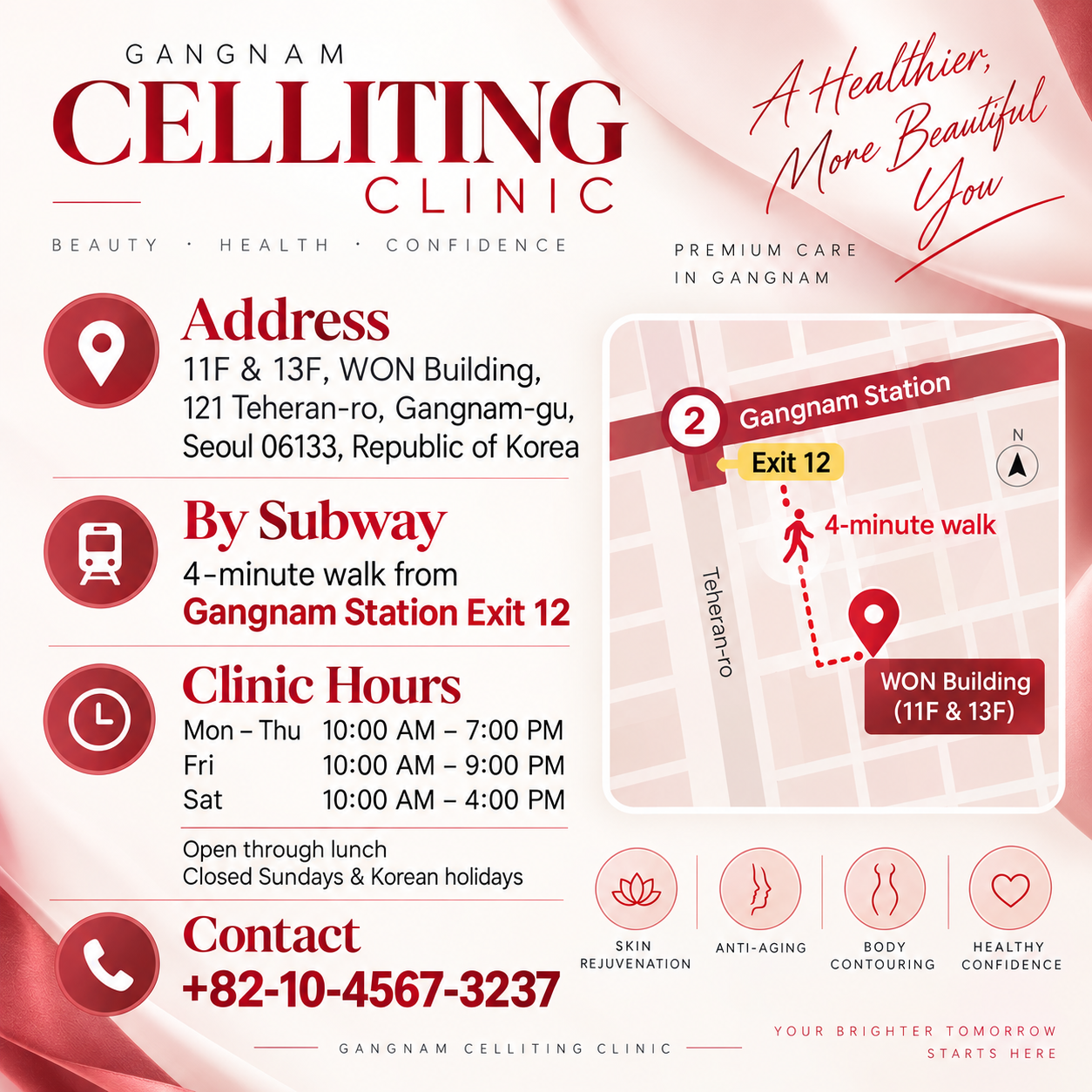
Gangnam Celliting Clinic · 121 Teheran-ro, Gangnam-gu, Seoul · Gangnam Station Exit 12 (4-min walk)
Nasolabial folds are best treated by addressing what pushes skin over the fold. When mid-face descent is the main cause, lifting the cheek with devices such as Ultherapy or Thermage FLX may soften the fold. When volume loss dominates, filler or a collagen stimulator such as Sculptra may be considered. Many faces need a careful mix.
The nasolabial fold deepens mainly because the mid-face descends and loses volume, so cheek tissue rests more heavily against the fixed line beside the nose and mouth. Everyone has this fold; it is part of normal facial anatomy. With age, cheek fat pads move downward, bone support at the upper jaw slowly reduces, and skin loses elasticity. Repeated smiling also contributes.

Lift when tissue has moved; fill when volume has gone; combine when both have happened. A doctor checks this by watching how the fold changes when you lie back or gently lift the cheek with a fingertip.
| Approach | Best for | How it works | Things to know |
|---|---|---|---|
| Energy-based lifting | Mid-face descent, laxity | Ultrasound or RF heat tightens deeper tissue | Changes develop gradually |
| Filler | Localised volume loss | Restores support near the fold | Early visible change; amount matters |
| Collagen stimulator | Broad volume loss, thin skin | Sculptra prompts your own collagen | Builds gradually over sessions |
| Skin-quality care | Etched surface lines | Boosters and regenerative treatments | Supports texture, not lift |
| Combination | Descent plus volume loss | Lift first, then support volume | Planned in stages |
For a full comparison of devices, see skin lifting devices compared. Volume changes higher on the face are covered in best treatments for cheek volume loss.
Over-filling the fold can make the mid-face look heavy and unnatural, which is why conservative amounts matter. Repeated filler placed directly in the line, without addressing the cheek, may create a puffy ridge next to the mouth or a wider-looking lower face. It can also make smiling look stiff. Doctors reduce this risk by:

Suitability is a medical decision made by your doctor after an in-person consultation and review of your health history.
The doctor views your face sitting and lying back to see how much the fold depends on gravity.
The mid-face, lower face and jawline are assessed together, not just the line.
You receive a staged plan explaining what each step can change and why.
Pain-control options such as topical anaesthesia or AirNox are matched to the procedure.
Swelling settles over days; follow-up continues for 3 months after you go home.
Written aftercare in your language, a 24-hour line and a free 3-month follow-up.
No serious complication since 2007. FDA/KFDA-cleared devices and verifiable, genuine consumables.
Monitored sleep sedation, AirNox analgesia, the X-injector or local anesthesia, matched to the procedure.
Many international patients start with energy-based lifting, since it has minimal downtime and can be done early in a visit to Gangnam, Seoul. The clinic's One-Day Combined Face Lifting, taking about 60 minutes to 2 hours, may suit those short on time. If filler is added, plan it a few days before your flight so swelling can settle. Collagen-stimulating plans often need repeat sessions, which can be scheduled across return trips.
Reviewed by Dr. Ho-chan Kim, MD, PhD · Updated October 2026
No, and it should not. The fold is a natural part of the face, visible even in young people when smiling. Treatment aims to soften a fold that has become deep or heavy, keeping a natural transition between the cheek and the mouth.
Because the fold is often deepened by cheek descent or volume loss above it. Supporting or lifting the cheek can reduce the weight pressing on the fold, which may look more natural than filling the line directly. The doctor explains this reasoning during assessment.
Sculptra is a collagen stimulator rather than an immediate filler. It encourages your own collagen to build gradually over a series of sessions, so change is slower but broader. Gangnam Celliting Clinic presents itself as "The Original Sculptra Training Center", with Sculptra experience since 1999.
For suitable patients with mild to moderate descent, lifting with ultrasound or radiofrequency may soften the fold gradually. When significant volume has been lost, lifting alone may not be enough, and a combination is often discussed.
Often, yes, but tell the doctor what was used and when. Existing product affects the plan, and adding more without assessment increases the risk of a heavy look. Bring any records from previous treatments if you can.
Send front and side photos on WhatsApp, and our doctors in Gangnam, Seoul will explain what is shaping your folds.
Medical information on this page is provided by Gangnam Celliting Clinic and reviewed by our medical directors. It is not a substitute for an in-person medical consultation. Individual results vary, and all procedures carry potential risks and side effects that your doctor will explain before treatment.
From skin lifting and stem cell treatments to regenerative skin care, our two MD-PhD directors plan every treatment personally. Send us your questions and travel dates.
Everything you need to plan a treatment trip to Seoul




How to find us

WhatsApp :
+82-10-4567-3237
Address : 11F & 13F, WON Building, 121
Teheran-ro, Gangnam-gu, Seoul 06133, Republic of Korea
Gangnam Station, Exit 12